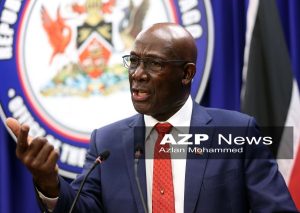


Caption: Minister of Economic Development, Planning, Agriculture and Lands, Forestry, Blue Economy, Marine Resources and Cooperatives, Lennox Andrews speaking at news conference on Wednesday: Photo: CMC
Summary
- Ban Lifted: The United States has officially lifted its ban on Grenada’s fish and fish product exports, restoring a vital industry that accounts for over EC$50 million in annual trade. The clearance is valid through December 31, 2029.
- Why It Happened: The US National Oceanic and Atmospheric Administration (NOAA) originally imposed the ban because Grenada’s fishing operations did not meet US marine mammal protection standards.
- Legislative Action: To achieve compliance, Grenada passed the Fisheries (Amendment) Bill 2025, introducing strict conservation measures, a fisheries observer program, and heavy penalties for violations. Officials warn that continuous monitoring is required to prevent future bans.
ST GEORGE’S – THE Grenada government on Wednesday confirmed that a fisheries ban imposed by the United States has been lifted, even as St George’s acknowledged that there is still more work to be done.
The US National Oceanic and Atmospheric Administration (NOAA) imposed the ban on fish and fish products because Grenada failed to provide a “comparability finding” under the Marine Mammal Protection Act (MMPA), which requires that foreign fishing operations do not kill or seriously injure marine mammals more often than US vessels.
Grenadian authorities said the ban was a severe blow, impacting over EC$50 million (US$1.00 = EC$2.70) in annual exports. The exports primarily consist of yellowfin tuna, which represents a key sector for Grenada’s economy and supports thousands of jobs.

In response to the ban, the Grenada government passed the Fisheries (Amendment) Bill 2025, which introduced stricter conservation measures, including a fisheries observer program, enhanced monitoring for longline vessels, and penalties of up to EC$100,000 for violations.
Speaking at a news conference on Wednesday, the Minister of Economic Development, Planning, Agriculture and Lands, Forestry, Blue Economy, Marine Resources and Cooperatives, Lennox Andrews, said the government delayed announcing the lifting of the ban to ensure the official notice had been published in the US Federal Register.
In addition, he said Grenada had to receive the official advice from NOAA, which was dated March 13, 2026.

Andrews said the letter states that the comparability finding determinations for Grenada are valid through December 31, 2029.
“During this period, NOAA Fisheries may reconsider and may terminate a comparability finding if it is determined, based on any progress report or other available information, that Grenada’s regulatory programme no longer meets the applicable conditions for a comparability finding.
“Therefore, NOAA Fisheries strongly encourages Grenada to maintain and, where possible, [improve] its efforts to minimise the incidental mortality and serious injury of marine mammals associated with your nation’s commercial fisheries,” Andrews quoted from the letter.
“So essentially, there are really and truly two main issues coming out of this letter. The first, and to put it simply, is that the prohibition has been lifted, and that lifting of the prohibition remains in effect until December 31, 2029.

“Therefore, what that means is that our fisherfolk can now go out to sea and continue fishing… But I want to say this: Achieving this goal was no easy task. It required action with alacrity to set up a task force with specific limits and to collaborate with a number of people and institutions on a constant basis, as well as monitoring and reporting to Cabinet on developments with NOAA.”
Andrews expressed thanks to a number of stakeholders, including the Organisation of Eastern Caribbean States (OECS) Commission, officials from the United States Embassy in Barbados, and the Food and Agriculture Organization (FAO).
He noted that the FAO assisted with the drafting of the legislation, “and they are still doing so.”