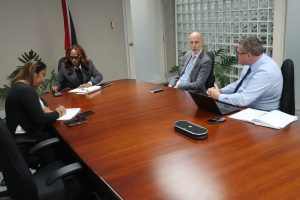

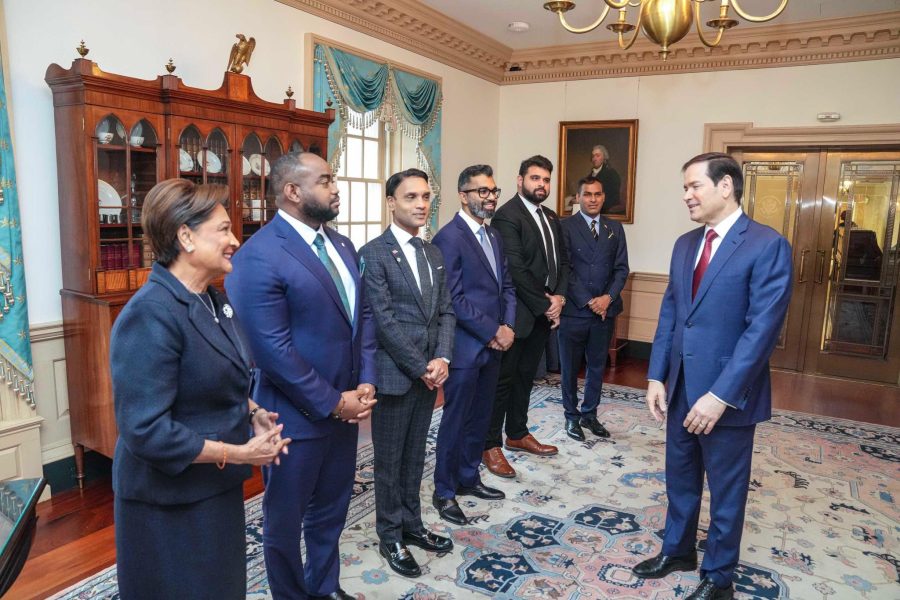
Caption: Prime Minister Kamla Persad-Bissessar, left, speaks with US Secretary of State Marco Rubio, right, at the State Department in Washington, DC last year. From left, Sean Sobers, Minister of Foreign and Caricom Affairs; Barry Padarath, Minister of Public Utilities; Saddam Hosein, Minister of Legal Affairs; Nicholas Morris, Parliamentary Secretary in the Ministry of Foreign and Caricom Affairs; and Randall Karim, Head of the Foreign Service.
By Prior Beharry
THE US Treasury Department’s Office of Foreign Assets Control (OFAC) on Friday issued new licences easing restrictions on energy companies operating in Venezuela’s oil and gas sector, a move welcomed by Prime Minister Kamla Persad-Bissessar as a potential boost for regional energy cooperation and cross-border development.
In a social media post Friday afternoon, Persad-Bissessar said the two licences—Nos. 49 and 50—provide a “clear” and “structured” legal framework under US law for oil and gas activity along Trinidad and Tobago’s shared maritime border with Venezuela.
“As a longstanding close partner of the United States, Trinidad and Tobago views this development as an important opportunity to deepen hemispheric energy cooperation, strengthen regional stability, and reinforce trusted commercial ties,” she said.

“We are optimistic about the potential to enhance our role as a responsible energy hub in the Caribbean, supporting domestic industry, safeguarding jobs, and contributing to reliable supply chains that benefit the wider region. Trinidad and Tobago will proceed in full compliance with applicable legal and regulatory requirements and in keeping with our commitment to transparency and sound governance,” she added.
OFAC’s Licence 50 names Chevron, BP, Eni, Shell and Repsol, authorising transactions related to Venezuela’s oil and gas sector, including activities previously barred under the Venezuela Sanctions Regulations (31 CFR Part 591). Under the licence, contracts with Venezuela’s government or state oil company Petróleos de Venezuela, S.A. (PdVSA) must be governed by US law. It also requires that monetary payments to individuals or entities blocked by the US be paid into a Foreign Government Deposit Funds account, created by executive order in January.
Licence 49 provides similar scope for other global companies, but requires separate OFAC authorisation for contracts. It allows the negotiation and signing of “contingent contracts” for new exploration, development or production in Venezuela, expansion of existing operations, and the formation of new joint ventures or related entities.

Both licences bar payment terms deemed not “commercially reasonable,” including debt swaps, gold payments, or transactions denominated in digital currency or tokens issued by or on behalf of the Venezuelan government. They also prohibit transactions involving persons located in the Russian Federation, Iran, North Korea, Cuba, China, or entities owned or controlled by those persons, including joint ventures.
The shift is the most significant relaxation of US restrictions affecting Venezuela’s energy sector since the removal of former president Nicolás Maduro in early January.
In Trinidad and Tobago, the new OFAC action is being closely watched in relation to the stalled Dragon gas project—an initiative to develop the Dragon gas field in Venezuelan waters near the maritime border. The field is estimated to hold between 3.2 trillion and 4.2 trillion cubic feet of natural gas.
Attorney General John Jeremie had previously said the Dragon arrangement had “come alive” again following Maduro’s removal. A prior Dragon-related licence negotiated under the former administration was revoked in early April. After taking office, the UNC-led government submitted a new application on May 19, Jeremie said.
The OFAC licence is described as the first step in a three-tier approval process. It authorises the US and Trinidad and Tobago governments, the National Gas Company of Trinidad and Tobago (NGC), Shell Plc and Futura Clara Ltd to enter negotiations with Venezuela’s government and PdVSA for the Dragon field’s development.
The Dragon initiative has also been a source of tension between the two countries. Venezuela’s interim president, Delcy Rodriguez, previously criticised the US and the Persad-Bissessar administration, saying in October that the Prime Minister was leading Trinidad and Tobago “off a cliff” on the Dragon deal. Last year, Venezuela declared Persad-Bissessar persona non grata and severed energy agreements with Trinidad and Tobago.