
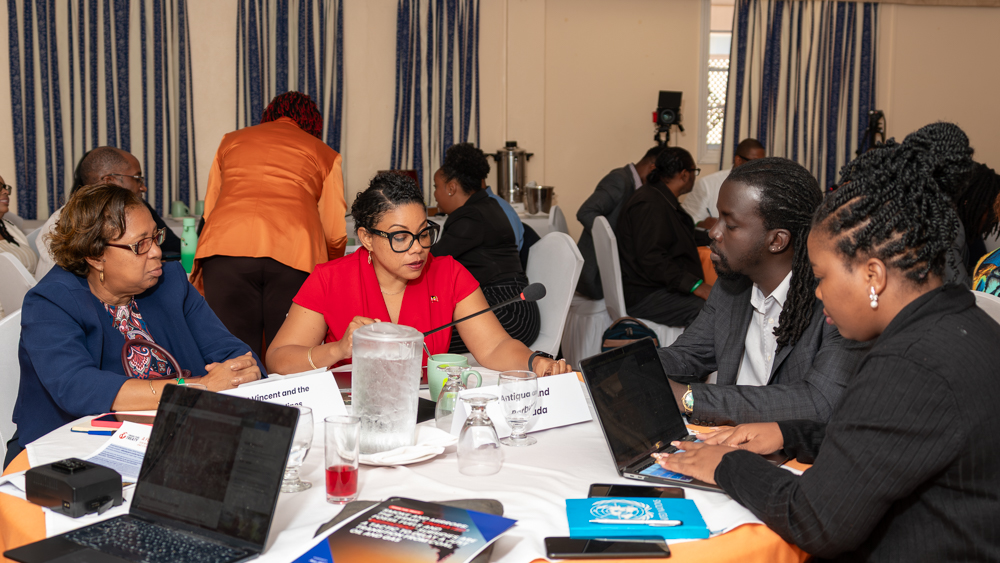
Caption: Regional government officials and civil society leaders participating in the Caribbean Convening on a Global Just Transition from Fossil Fuels meeting, on March 2-3, 2026, in Gros- Islet, Saint Lucia. Photo: See.Capture.Inspire.
Summary
- Regional Strategy Formed: Caribbean government officials and civil society leaders met in St Lucia (March 2–3, 2026) to coordinate a unified regional stance on a global just transition from fossil fuels.
- Preparing for Santa Marta: The convening served as a critical preparatory session ahead of the first International Conference on Transitioning Away From Fossil Fuels in Colombia this April.
- Financial Demands Highlighted: Leaders stressed that transitioning requires unprecedented international cooperation, large-scale concessional finance, and debt reform to ensure Small Island Developing States (SIDS) are not left behind.
- Climate Impacts are Real: Civil society representatives highlighted the severe, ongoing cost of inaction in the Caribbean, pointing to recent devastation from Hurricane Melissa.
- A Call for a Financed Phase-Out: The region is demanding a fast, fair, and financed global phase-out of oil, gas, and coal to keep the critical 1.5°C global warming limit within reach.
By Suemita Teeluck
CARIBBEAN senior government officials and civil society leaders met on March 2 to 3 2026 at Gros-Islet, Saint Lucia, for the Caribbean Convening on a Global Just Transition from Fossil Fuels.
The two-day meeting served as a preparatory session, reaffirming the region’s commitment to shaping international cooperation toward a fast, fair, and financed global phase-out of oil, gas, and coal. Despite growing global consensus on the need to transition away from fossil fuels, international climate and financing discussions continue to face gridlock, even as climate impacts intensify worldwide.

The convening builds on recent global climate summits. The United Nations Climate Change Conference (COP28) closed with an agreement that signaled the “beginning of the end” of the fossil fuel era, laying the ground for a “swift, just, and equitable transition” underpinned by deep emissions cuts and scaled-up finance. In a demonstration of global solidarity, negotiators from nearly 200 Parties came together in Dubai with a decision on the world’s first ‘global stocktake’ to ratchet up climate action before the end of the decade—with the overarching aim to keep the global temperature limit of 1.5°C within reach.
However, subsequent talks have faced challenges. Expectations were high that COP30’s final decision would include an explicit reference to phasing out fossil fuels, with more than 80 countries backing Brazil’s proposal for a formal roadmap. Instead, the final decision emphasized solidarity and investment, setting ambitious financial targets while leaving the energy transition for later discussion. Because the burning of fossil fuels remains by far the largest contributor to global warming, this omission became a point of concern for many nations and civil society groups.

Before that final plenary, Brazilian scientist Carlos Nobre issued a stark warning: fossil fuel use must fall to zero by 2040—or 2045 at the latest—to avoid catastrophic temperature rises of up to 2.5°C by mid-century. That trajectory, he said, would spell the near-total loss of coral reefs, the collapse of the Amazon rainforest, and an accelerated melt of the Greenland ice sheet. Furthermore, the 2025 UNEP Production Gap Report predicts that governments are currently projected to produce 120% more fossil fuels by the year 2030 than is consistent with limiting warming to 1.5°C.
Several Caribbean countries were vital to the conversation that secured the 1.5°C limit under the Paris Agreement, and they are among the 18 countries currently in talks regarding the proposed Fossil Fuel Treaty.
Ms. Charlin Bodlee, Chief Technical Advisor for the Caribbean Centre for Renewable Energy and Energy Efficiency (CCREEE), noted that Caribbean states face a severe climate finance gap and rely heavily on loan-based funding. “Addressing this will require large-scale debt-sensitive mechanisms, increased grant finance, and innovative structures,” she said.
Dr. James Fletcher, Executive Director of the Caribbean Community Climate Change Centre, stated that Caribbean society has fought to secure the 1.5°C goal through global advocacy for Loss and Damage. He highlighted that any transition must include concessional finance, debt reform, expanded energy access, renewable scale-up, and social protection for affected communities.
Echoing this urgency, Alex Rafalowicz, Executive Director of the Fossil Fuel Treaty Initiative, warned, “The 1.5°C limit is at risk—and we must be clear about why.” He stressed that the primary drivers of emissions, public health crises, and pollution impacts are coal, oil, and gas.

The Caribbean’s position
The St. Lucia meeting strengthened regional coordination and clarified Caribbean priorities ahead of the upcoming Santa Marta Conference.
Day one convened civil society representatives to examine the scientific, legal, and multilateral context for a fossil fuel transition, including the role of Nationally Determined Contributions (NDCs), and to define shared priorities and red lines. Day two brought together senior government officials to assess barriers and opportunities for transition specifically in the Caribbean context, concluding with an agreement on the core elements of a coordinated regional position.
Dr Theresa Rodriguez-Moodie, Chief Executive Officer of the Jamaica Environment Trust, reminded attendees of the immediate stakes. “In the wake of Hurricane Melissa, Jamaica faced the stark reality of loss and damage: communities were submerged, roads rendered impassable, and homes and buildings destroyed,” she said. She said that hospitals and critical infrastructure sustained severe damage, thousands were displaced, agriculture suffered heavy losses, and families were left trying to determine what could be salvaged from disrupted power and water systems.
Regional representatives will travel to Colombia with several important questions for global leaders. Government officials have called for a clear understanding of what a transition actually requires of their economies and societies. They are advocating for international compensation for leaving resources untapped, while also stressing that workforce reskilling is vital for a successful transition.

A closer look
For Caribbean civil society, climate action is a legal and human rights obligation. Communities across the region are already bearing the cost of inaction. Continued fossil fuel exploration in this context is neither just nor sustainable; it entrenches the very systems driving the region’s vulnerability. At the same time, an unmanaged transition risks worsening inequality and undermining economic and social rights, underscoring the need to empower workers and communities to participate meaningfully in emerging green sectors.
The announcement of this landmark convening comes at a pivotal moment, marked by a growing disconnect between global fossil fuel production plans and what is required to limit warming to 1.5°C. By 2050, production is expected to be 4.5 times higher than what a 1.5°C pathway allows, highlighting the urgency of a coordinated global effort to phase out coal, oil, and gas.
As the Fossil Fuel Treaty Initiative reemphasised: “… fossil-fuel-dependent nations want to end their dependence on oil, gas, and coal extraction, but doing so fairly requires unprecedented international cooperation so that no one is left behind.”
As preparations continue for the first International Conference on Transitioning Away From Fossil Fuels, scheduled for April 24 to 29 in Santa Marta, Caribbean stakeholders have made their shared commitment clear: any global phase-out framework must reflect the principles of equity, responsibility, and unwavering support for Small Island Developing States.