
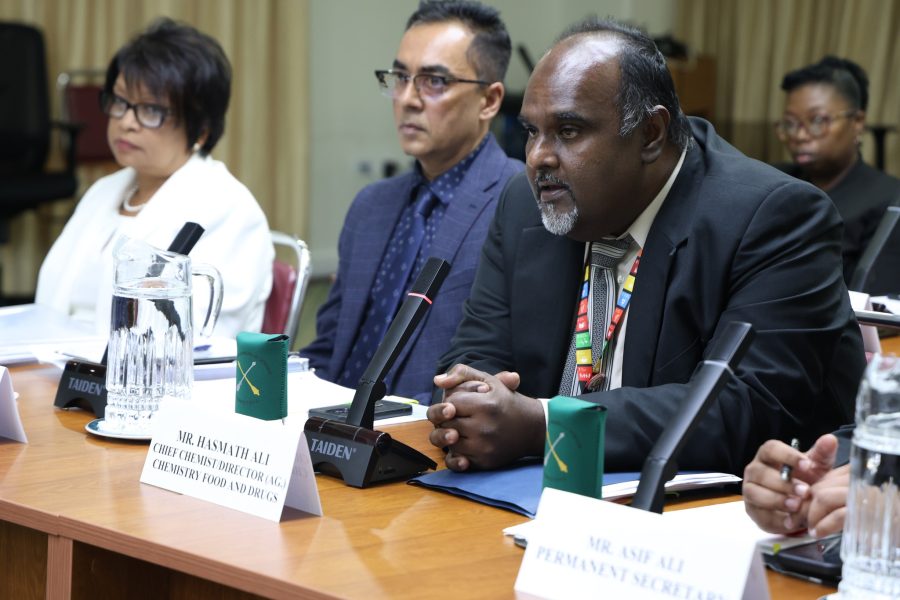
Caption: Acting Chief Chemist and Director of the Chemistry, Food and Drug Division, Hasmath Ali. Photo: T&T Parliament
Summary
- A parliamentary committee heard that additional drug-import requirements were added in 2017 to Regulation 3 without legislative approval.
- The changes were described as the work of a ‘rogue public servant,’ not the Drug Advisory Committee, and remained in place until 2025.
- Acting Chief Chemist Hasmath Ali confirmed the changes were made and had no basis in law, but said he could not identify who ordered them.
- Ali said the issue surfaced after complaints from smaller importers/distributors who struggled to meet the added documentation demands.
- Committee chair Jagdeo Singh plans to call former officials, including the then DAC secretary and a former chair, to clarify who authorized the changes and whether they favoured certain importers.
By Alicia Chamely
ILLEGAL additions to the Food and Drug Act’s requirements for pharmaceutical importers—described as the work of a “rogue public servant”—have called the oversight and operations of the Ministry of Health’s Drug Advisory Committee (DAC) into question.
At Monday’s sitting of the Public Administration and Appropriations Committee, which is examining the state’s procurement of pharmaceuticals and the regulatory guidelines governing the industry, committee chairman Jagdeo Singh said that in 2017 additional requirements for the importation of pharmaceuticals were added to Regulation 3 without the legislative approval required.
The committee also heard that the additional requirements were not introduced by the DAC, but instead by a “rogue public servant,” and that the unlawfully enacted requirements were not detected or removed until 2025.

Addressing Acting Chief Chemist and Director of the Chemistry, Food and Drug Division, Hasmath Ali, Singh said: “I’m going to hold up a document in my hand, right, so that you know I’m not bluffing. Did the secretary to the Drug Advisory Committee in 2017 make changes to section three, which I just read out to you, without publishing those requirements?”
Ali replied: “Yes.”
Singh continued: “And those changes which were made had no basis in legislation?”
Ali again replied: “Yes.”
Asked who instructed that the changes be made—changes Singh argued made it extremely difficult for smaller importers to obtain approval for drug importation and distribution—Ali said he could not say.
Ali told the committee he became aware of the changes in 2025 after a series of complaints from smaller importers and distributors who could not easily supply the additional information and documentation, including items such as letters from the United States Department of Agriculture (USDA) drug division.
A frustrated Singh said: “So one morning, magically—as if to say someone woke up in 2017, marched into the ministry and gave instructions that the forms were to be amended. Where is that documented? Anywhere?”
Ali said that, following his inquiries, he could not find any documentation or DAC minutes identifying who was responsible for the supplemental requirements.
He confirmed the disputed requirements were removed in 2025, but said he was still unable to identify who directed that they be added to Regulation 3.

Singh said: “So this rogue public servant who enacted an ultra vires requirement for something as important as the importation of new drugs into Trinidad—this was allowed. This was allowed to continue unchecked and unabated for seven whole years, eight whole years, without anybody in the ministry realising that these forms introduced requirements that had no basis in law.
“Is that what you’re telling this committee and the members of the public? For eight years a patent, plain, lucid and palpable illegality was allowed to prevail in the importation of pharmaceuticals before anyone took any measure to arrest this action—is that what you’re telling me?”
Singh continued to press Ministry of Health representatives, insisting the directive must have come from somewhere.
“You cannot tell me a public servant took it on his own to do this without the involvement of other persons in the ministry,” he said. “Ministries just don’t function that way.”

Ali said the only person he could identify as being connected to the changes was the then secretary to the DAC, Dr Derek Patron.
Singh responded: “So Derek Patron issued instructions to the Government Printery to introduce additional requirements on a form, acting entirely on his own. That’s the story you’re trying to tell me here. That’s a narrative you’re conveying to me.”
Ali said he had approached Dr Patron, who advised him to speak to the DAC and did not confirm or admit he had made the changes.
Singh also questioned whether the changes were introduced to favour certain importers.
“Don’t you find it startling that those documents—these additional documents—could have been sourced by some importers and not sourced by others?” he asked.
Singh suggested it was reasonable to infer that the additional requirements, which he said were plainly ultra vires, created an onerous compliance framework that could have been designed to benefit a select few.
Ali replied: “Yes, sir.”
Singh said he intended to write to Dr Patron and the former chair of the DAC, Faz Khan, to appear before the committee to clarify the matter and confirm who directed that additional requirements be added to Regulation 3 without legal or legislative approval.