
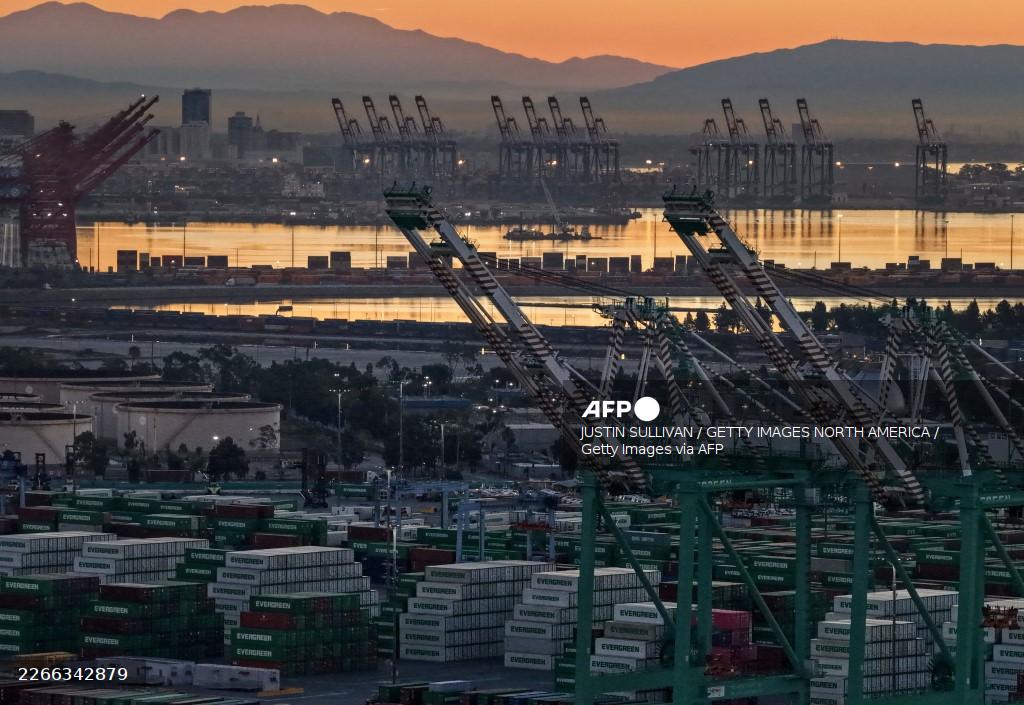
Caption: An aerial view of the Port of Los Angeles, California.
Summary
Global markets were volatile but resilient. U.S. equities posted losses over the week, with the S&P 500, Dow Jones, and Nasdaq declining as investors rotated into defensive sectors and energy stocks amid geopolitical uncertainty.
European and Asian markets weakened. Major indices in Europe and Asia fell due to concerns over rising energy costs, supply disruptions, and the economic impact of escalating tensions in the Middle East.
Iran–Israel conflict drove oil prices higher. Brent crude surged toward the US$103 per barrel level as markets priced in the risk of supply disruptions through the Strait of Hormuz, a critical global oil shipping route.
Higher oil prices are increasing global inflation risks. Rising energy costs could push global inflation higher, potentially delaying interest rate cuts by major central banks and increasing economic uncertainty.
Corporate earnings outlook is diverging by sector. Energy companies are expected to benefit from stronger revenues, while fuel-intensive sectors such as airlines, logistics, and manufacturing may face margin pressure.
Trinidad and Tobago may benefit from higher energy prices. Elevated oil and gas prices could strengthen government revenues, improve foreign exchange inflows, and support economic growth, though imported inflation remains a key risk.

GLOBAL financial markets experienced elevated volatility over the past week as investors reacted to escalating geopolitical tensions in the Middle East and reassessed the outlook for inflation, interest rates, and global growth. The intensifying conflict between Iran and Israel has emerged as the dominant macroeconomic driver of market sentiment, pushing energy prices sharply higher and creating uncertainty across equity, bond, and commodity markets.
In the United States, equity markets showed relative resilience despite the geopolitical shock. Major indices recorded modest losses for the week as investors rotated toward defensive sectors and energy companies that benefit from higher oil prices. The S&P 500 declined during the last week approximately 1.56%, while the Dow Jones Industrial Average fell around 1.99%. The Nasdaq Composite loss roughly 1.26%, supported by continued strength in large-cap technology stocks and optimism around artificial intelligence-driven productivity gains. However, sectors with high exposure to fuel costs including airlines, transportation, and consumer discretionary underperformed as rising energy prices threaten profit margins.

Energy companies were among the best performers during the week as crude oil prices surged amid concerns about supply disruptions in the Middle East. Major oil producers and oilfield services firms recorded strong gains, reflecting expectations that sustained oil prices above US$90 to US$100 per barrel would significantly increase cash flow and earnings. At the same time, investors remain attentive to U.S. inflation data and signals from the Federal Reserve regarding the path of interest rates. Markets continue to expect potential policy to be eased later in the year, although higher energy prices could complicate the inflation outlook.
European equity markets faced greater pressure during the week, reflecting the region’s sensitivity to energy price shocks. The STOXX Europe 600 Index declined approximately 0.47%, with major indices in Germany, France, and Italy also posting modest losses. European industrial companies and manufacturers were particularly affected as investors priced in higher energy costs and potential supply disruptions. Europe remains heavily dependent on imported energy, making the region vulnerable to geopolitical instability in major oil-producing regions.
Asian markets also experienced declines as investors adopted a more cautious stance amid rising geopolitical risk and higher commodity prices. Japan’s Nikkei 225 fell sharply during the week, while Chinese equities also moved lower as global risk sentiment deteriorated. Asian economies, particularly Japan, China, and South Korea are among the world’s largest energy importers and therefore face increased economic pressure when oil prices rise sharply. Higher energy costs may weigh on manufacturing activity, trade balances, and overall economic growth across the region.

Rising oil prices carry significant implications for the global economy. Energy costs feed directly into transportation, manufacturing, and consumer goods prices, creating renewed inflationary pressure. Economists estimate that sustained oil prices above US$90 per barrel could add meaningful upward pressure to global inflation, potentially delaying the timeline for central banks to reduce interest rates. Higher borrowing costs combined with rising energy prices could slow global economic growth if the conflict persists.
Corporate earnings will also be affected unevenly across sectors. Energy producers and oil service companies are likely to benefit from stronger revenues and improved margins. Conversely, sectors heavily dependent on fuel inputs, including airlines, logistics, chemicals, and heavy manufacturing, may experience margin compression as higher costs erode profitability. Consumer spending may also weaken if households face higher gasoline and transportation costs.
For energy exporting economies such as Trinidad and Tobago, the current environment presents both opportunities and risks. Higher oil and natural gas prices generally support government revenues, improve export earnings, and strengthen foreign exchange inflows. The Government of Trinidad and Tobago’s fiscal framework remains closely tied to hydrocarbon prices, and sustained oil prices above current budget assumptions could provide meaningful additional fiscal space.
Recent economic indicators in Trinidad and Tobago suggest gradual improvement in domestic economic activity. The energy sector continues to be the primary driver of economic growth, supported by ongoing upstream investments, the restart of previously idled production facilities, and renewed interest in natural gas development projects. Energy production levels have begun stabilizing following several years of declining output, providing some optimism for medium-term fiscal revenues.
Outside the energy sector, economic diversification efforts continue in areas such as financial services, manufacturing, and digital technology. Inflation has remained relatively contained compared with many developed economies, although imported inflation, particularly through food and fuel prices, remains a key risk for consumers. Monetary policy has remained relatively stable, with the Central Bank maintaining a cautious stance as it monitors global economic developments.
Looking ahead, global markets are likely to remain highly sensitive to developments in the Middle East. For Trinidad and Tobago in particular, sustained strength in global energy prices could provide an important tailwind for fiscal revenues and economic stability, although volatility in global markets underscores the importance of prudent fiscal management and continued economic diversification.
Dave Dookie is the Managing Director of Waterloo Capital Advisors Limited, a Trinidad and Tobago based financial advisory firm specialising in investment management, capital markets and structured finance. He has advised governments, financial institutions, and energy companies on debt issuance, project financing, and strategic capital raising across the Caribbean. He holds degrees and advanced qualifications from the London School of Economics and Political Science (LSE) and the University of London and has completed advanced training in data science through the MIT Applied Data Science Programme.