

Caption: Grumman’s AN/TPS-80 G/ATOR
By Prior Beharry
PRIME Minister Kamla Persad-Bissessar first revealed on November 27, 2025 that the US military was setting up a radar at the Tobago airport.
The Ground/Air Task-Oriented Radar (G/ATOR) official name is Grumman’s AN/TPS-80 G/ATOR and is now perched on top of a vehicle at the unfinished ANR Robinson International Airport in Tobago.

November 26: When questioned about the presence of US troops in Tobago before a sitting of the House of Representatives, Prime Minister Kamla Persad-Bissessar stated only that they were assisting with a roadway and “something to do at the (ANR Robinson International) airport.”
November 27: Following a laptop distribution ceremony at Penal Secondary School, Persad-Bissessar disclosed for the first time that US Marines were establishing a radar system. She said, “On further inquiries, yes, in Tobago, there are some (marines)… They’re helping with the runway and the road and a radar.”
November 28: Public reports of US Marines at a Tobago hotel and flight-tracking data showing military aircraft at ANR Robinson International Airport prompted further scrutiny.

December 1: On X, Persad-Bissessar said, “I requested a temporary radar system be installed here, and I am thankful that the US gave us one of the best systems available and the assistance to install and operate it.”
December 1: The prime minister told the Express: “Months ago I made the request to the local US Embassy for a US-supplied radar as a temporary solution for our poor surveillance capabilities. A system will also be installed at a site in Trinidad until a permanent replacement for our ineffective existing radar system can be installed.”
December 3: In an official release, Persad-Bissessar expanded on the radar’s capabilities, stating it provides a “superior layer of protection” to detect Venezuelan sanction-busting activities and the trafficking of narcotics, firearms, and migrants.
December 9: When asked about Homeland Security Minister Roger Alexander’s suggestion that the radar could assist in the Tardieu kidnapping case, she remained cautious, stating, “We shall see whether it can assist or not. We will have to wait.”

December 10: Defence Minister Wayne Sturge confirmed that the data from the radar is shared with Trinidad and Tobago.
December 11: Police Commissioner Allister Guevarro commended the effectiveness of the radar after police seized 1,560 kilograms of ‘creepy marijuana’ with an estimated street value of $171,205,320 in a boat in the Caroni Swamp.
December 11: During a speech at the CXC awards ceremony, the Prime Minister credited the new installation, announcing, “Using the radar that we installed in Tobago, we were able today to drug bust $171 million worth of illegal drugs.” She also revealed an off-script detail: “Today I met with some officials from the US Embassy this evening before I came.”
December 12: Persad-Bissessar followed up on Facebook regarding her meeting with US officials, noting simply that they “discussed our continued co-operation in the fight against crime.”
December 16: A New York Times article stated that the radar in Tobago only does air surveillance. It noted that the Northrop Grumman’s website states that with a single scan, the G/ATOR delivers the data necessary for air defense weapons to destroy airborne threats including cruise missiles, hypersonic missiles, ballistic missiles, manned aircraft and drones. It “determines launch points of hostile fire, such as rocket, artillery, or mortar fire, for counter strikes against the sources of each threat,” according to the product description.
US build up in the Caribbean
The radar is a sophisticated, 3D multi-role radar capable of tracking medium to long-range threats, including drones, cruise missiles, rockets, artillery, and mortars.
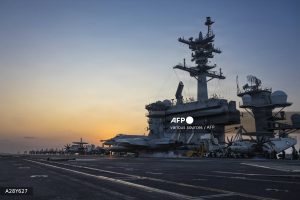
Persad-Bissessar has been a vocal proponent of the American military buildup in the Southern Caribbean, which started in August with the arrival of three guided-missile destroyers: the USS Gravely, USS Jason Dunham, and USS Sampson. Since then, the US presence has expanded significantly to include the nuclear submarine USS Newport News, the aircraft carrier USS Gerald R Ford with its strike group, and the 22nd Marine Expeditionary Unit (MEU). Notably, the MEU conducted joint training with the Trinidad and Tobago Defence Force (TTDF) just last month.
Washington’s deployment of significant military presence in the Caribbean is officially to combat drug trafficking destined for the United States. Caracas believes this is an operation aimed at ousting Maduro from power and seizing the country’s vast oil reserves.
Persad-Bissessar has aligned herself with the Trump administration’s stance that these manoeuvers are counter-narcotics operations, even supporting US strikes on suspected drug vessels—actions that other nations have condemned as extrajudicial killings.
Regarding regional tensions, she stated in August that Trinidad and Tobago would permit US forces to utilise its territory if Venezuela invaded Guyana, provided the US made a formal request. This cooperation would fall under the Status of Forces Agreement (SOFA), a bilateral military pact signed in December 2024 by the previous PNM administration.
The dispute between Venezuela and Guyana over the Essequibo region remains a long-standing point of contention.