

Caption: (FILES) An F-18E fighter jet takes off from aircraft carrier USS Gerald R Ford
By Alicia Chamely
US Military aircraft have been granted permission to transit through Trinidad and Tobago’s airports in the coming weeks.
In a media release on Monday, the Ministry of Foreign and CARICOM affairs, stated, “In keeping with established bilateral cooperation, the Ministry has granted approvals for the United States military aircraft to transit Trinidad and Tobago’s airports in the coming weeks.”

The ministry stated the transit of the military aircrafts was not related to any defence posturing with Venezuela, but were logistical exercises facilitating supply replenishment and routine personnel rotations.
Affirming T&T’s commitment to sustained and collaborative cooperation with the US in fortifying regional security and stability, the ministry stated T&T had most recently benefited from joint military training exercises and enhanced surveillance capabilities.
It noted that these enhanced surveillance capabilities included the installation of the military radar in Tobago, which “contributed to the interdiction of millions of dollars’ worth of illegal narcotics.”

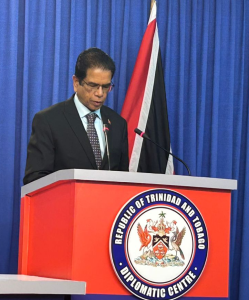
Confirming his ministry’s close engagement with the United States Embassy in T&T, Minister of Foreign and CARICOM Affairs, Sean Sobers stated in the release that he welcomed all support from the United States when it came to national security.
He confirmed Prime Minister Kamla Persad-Bissessar’s support, stating that she “has affirmed the government’s commitment to cooperation and collaboration in the pursuit of safety and security for Trinidad and Tobago and the wider region. We welcome the continued support of the United States.”
In November, it was reported US Military aircraft had transited through the ANR Robinson International Airport, Tobago. Later it was revealed the US Military was in Tobago to install a military radar, which Persad-Bissessar stated she had requested from the US to enhance T&T’s border protection abilities. The government had denied the radar was installed to facilitate the US’s Operation Southern Sphere aimed at dismantling Venezuelan cartels and force regime change.

The US began deploying military assets into the Caribbean in late August, to combat the Latin American drug trade originating from Venezuela.
As of August 29, seven US warships, along with one nuclear-powered fast attack submarine, were in and around the Southern Caribbean, bringing along more than 4,500 sailors and marines.
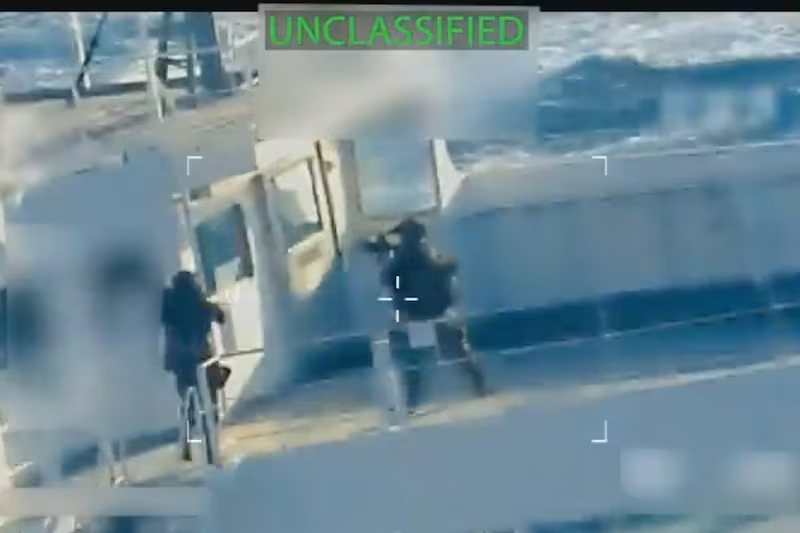
On September 2, the US military made its first strike against alleged drug smugglers. To date the US military had killed approximately 80 persons accused of transporting drugs via boat from Venezuela.

By mid-December the US had begun deploying more aircraft, with military experts weighing as to whether these signalled possible land strikes on Venezuela.
US Military aircraft reported to be present in the Caribbean, specifically at air bases in Puerto Rico and the Dominican Republic, were: F-35 Lightning II, F/A-18 Super Hornet, AC-130J Ghostrider, B-1 and B-52 Bombers, AV-8B+ Harrier.