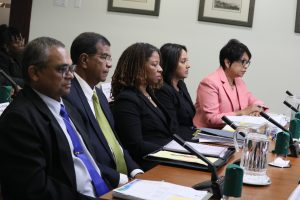


Caption: General Manager of NIPDEC Vyas Ramphalie, left, and Head, Finance and Accounting Jabari Cozier. Photo: T&T Parliament
Summary
- Testimony at the PAAC inquiry suggests Ministry of Health officials instructed NIPDEC to prioritise payments to larger pharmaceutical companies.
- Emails from 2023–2024 allegedly show Permanent Secretary Asif Ali directing NIPDEC to “bump up” payments to certain vendors while smaller suppliers were bypassed.
- Committee chairman Jagdeo Singh said one company reportedly received $50 million out of an $80 million allocation for pharmaceutical payments.
- NIPDEC officials confirmed that payment priorities were discussed during a meeting attended by ministry officials and former health minister Terrence Deyalsingh.
- Deyalsingh has denied the allegations, describing the committee’s investigation as a ‘witch hunt.’
By Alicia Chamely
CONTINUED testimony from officials of the National Insurance Property Development Company Limited (NIPDEC) has revealed that Ministry of Health officials, including former health minister Terrence Deyalsingh, allegedly instructed the company to prioritise or “bump up” payments to certain large pharmaceutical companies.
The claims emerged during Monday’s Public Administration and Appropriations Committee (PAAC) inquiry into the state’s acquisition of pharmaceuticals. Both NIPDEC and the Ministry of Health’s Food and Drug Advisory Committee have come under scrutiny for alleged procedural and regulatory abuses that may have favoured larger pharmaceutical companies.
Email correspondence from 2023 and 2024 presented to the committee showed that the Ministry of Health’s Permanent Secretary, Asif Ali, allegedly acting under instructions from Deyalsingh, directed NIPDEC to prioritise payments to certain suppliers while smaller companies were bypassed.
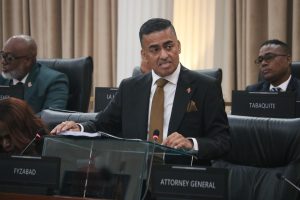
Questioning NIPDEC General Manager Vyas Ramphalie, PAAC Chairman Jagdeo Singh referenced an email exchange between Ali and NIPDEC’s head of finance and accounting, Jabari Cozier. According to Singh, Ali instructed Cozier on several occasions to “bump up the payment amounts of some vendors, take away allocations for others, and concentrate on the bigger players while factoring out the small players.”
Singh listed several large pharmaceutical companies and asked Ali whether those were the companies NIPDEC had been instructed to prioritise.
Ali responded, “That’s correct.”
Turning to Cozier, Singh referred to another chain of emails discussing an $80 million allocation to NIPDEC to pay pharmaceutical suppliers.
Cozier acknowledged the correspondence.
Singh continued: “Out of that allocation of $80 million to pay pharma suppliers, did Smith Robertson receive $50 million? One company received close to half of the money.”
Singh noted that several smaller companies had invoices outstanding for more than 180 days, and in some cases for years, while the ministry had directed NIPDEC to allocate the majority of funds to a single company.
He also presented another email in which Ali allegedly instructed that payments to two smaller companies be delayed in order to increase payments to another large supplier.
Further correspondence suggested that this practice had occurred repeatedly, with allocations provided by the Ministry of Health to NIPDEC often accompanied by instructions to prioritise larger pharmaceutical companies.
Both Ramphalie and Cozier confirmed that the distribution of funds was discussed during a meeting at the Ministry of Health.
Questioning Ramphalie, Singh asked whether ministry officials and the health minister were present at the meeting where payment priorities were discussed.
“The meeting is convened. Several people are there, including officials of the Ministry of Health, the accounting officer and the minister. Am I correct?” Singh asked.
“Yes, you’re correct,” Ramphalie replied.
Singh then asked whether the prioritisation of payments was discussed at that meeting.
“Yes,” Ramphalie said.
Listing the companies identified as receiving preferential payments, Singh further asked whether the minister had been present when those discussions took place and whether he had given the instructions.
Ramphalie replied, “Yes, Chairman.”
Deyalsingh attended the committee’s meeting but was not called upon to testify.
He has previously described the allegations against him as “false,” claiming the committee’s investigation amounts to a “witch hunt.”