

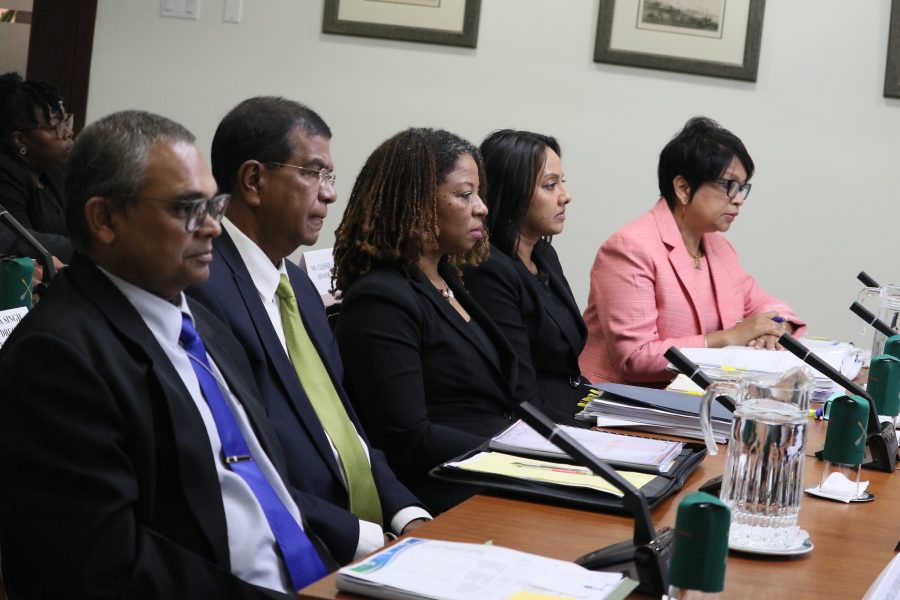
Caption: Officials from the Ministry of Health, Chemistry, Food and Drugs Division, The Office of the Procurement Regulation, National Insurance Property Development Company Limited (NIPDEC), Private Pharmacy Retail Business Association appearing before the Public Administration and Appropriations Committee. Photo: T&T Parliament
Summary
- Former Food and Drug Advisory Committee Technical Secretary Dr Deryck Pattron denied allegations he illegally introduced new pharmaceutical import requirements.
- Acting Chief Chemist Hasmath Ali previously told the PAAC that Pattron created Forms A and B, which were not part of the Food and Drug Act.
- Pattron insisted the forms were historical guidelines that existed before he assumed the post in 2017.
- PAAC Chairman Jagdeo Singh said the committee had received conflicting testimony from Ali and Pattron.
- The committee raised concerns that the additional forms may have disadvantaged smaller pharmaceutical importers while benefiting larger companies.
By Alicia Chamely
ACCUSED of being a “rogue public servant”, former Technical Secretary of the Ministry of Health’s Food and Drug Advisory Committee, Dr Deryck Pattron, has denied allegations that he illegally added new requirements for importing pharmaceuticals during his tenure.
Pattron appeared before the Public Administration and Appropriations Committee (PAAC) on Monday after Acting Chief Chemist and Director of the Chemistry, Food and Drug Division (CFDD), Hasmath Ali, alleged that he had unilaterally introduced additional documentation requirements known as Form A and Form B.

Ali made the allegations during the committee’s March 23 meeting, claiming the forms were not part of the Food and Drug Act and had made it extremely difficult, if not impossible, for smaller pharmaceutical companies to import drugs.
During Monday’s hearing, PAAC Chairman Jagdeo Singh directly questioned Pattron about the claims.
“The major allegation made against you, as you know, was that you, in 2017, unilaterally changed the form,” Singh said.
“Did you change the form, Dr Pattron? Yes or no?”
Pattron firmly denied the accusation, stating the forms were already in use when he assumed the position in 2017.
“No. It wasn’t a decision made by me,” he replied.

Pattron explained that the requirements referred to as Form A and Form B were not scheduled forms under the law but guidelines historically provided to pharmaceutical importers.
“The Form A and B that you’re referring to are not scheduled forms. These are guidelines that were provided to importers historically before me. My predecessor used those forms. Those forms are not new forms. They were used before even my time,” he said.
However, Singh pointed to what he described as inconsistencies between Pattron’s statements and evidence previously submitted to the committee. He asked Pattron to identify where in the minutes of a February 24 meeting of the Food and Drug Advisory Committee the decision to introduce the forms had been recorded.
“I have the February 24 meeting minutes in my hand. I’m simply asking you to point to the page where that decision was made,” Singh said.
Pressed further, Singh asked who took the decision to introduce Forms A and B.
“That was not our decision. That decision was done previously by the previous Secretariat,” Pattron responded.
Singh also questioned whether there was any legal basis for requiring the additional forms, noting that the Food and Drug Act only specifies Forms C, D and E.
“Do you agree with me that there was absolutely no basis in law to ask importers for Form A and Form B?” Singh asked.
Pattron maintained that the forms were merely guidelines and reiterated that their use predated his tenure.
Singh then referenced Ali’s earlier testimony, which alleged that Pattron had introduced the forms without authorisation in 2017.
“So when Mr Ali came and told this committee two or three weeks ago that you unilaterally changed these forms without jurisdiction, that is totally untrue?” Singh asked.
“That’s totally untrue,” Pattron replied.
Singh said the conflicting testimony raised serious concerns for the committee.
“This is troubling, to say the least,” he said. “We have two bits of evidence that are diametrically opposed to each other.”
He said the committee would need to determine which account was accurate.
Singh also noted that the addition of Forms A and B may have created opportunities for larger pharmaceutical companies to obtain special permission to import drugs while potentially limiting smaller companies from importing competing medications.