
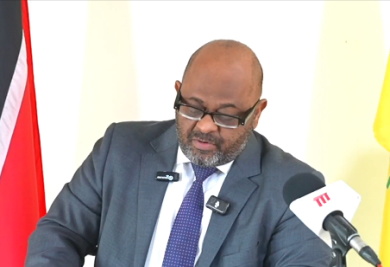
Caption: Wayne Sturge. Photo: CMC
DEFENCE Minister Wayne Sturge says he remains optimistic that the Senate will give approval to the Law Reform (Zones of Special Operations (ZOSO) legislation that was passed during the early hours of Saturday morning in the House of Assembly.
The Senate meets on Tuesday to debate the measure, and unlike the Lower House, where the government enjoys the necessary two-thirds majority to have ensured its passage, the Kamla Persad-Bissessar administration will need support at least from four independent legislators for the measure to become law.
In the Parliament over the weekend, where the government enjoys a 28-13 majority, the bill passed by 27-11 majority with no abstentions.
Prime Minister Persad-Bissessar said the state of emergency (SoE) which government declared last July and extended three months later will end on January 31.

Former prime minister Stuart Young said the country is “seeing dangerous developments under the UNC (United National Congress) government. The Zones of Special Operations Bill that they forced through parliament after 3 am on Saturday 17 January 2026 is dangerous and will lock down specific neighbourhoods.”
Young said during the debate that the “government stood here in the exact House and Chamber and told the country that the state of emergency is not their crime plan. The evidence and history have proven it to be untrue.
“It is their crime plan and today we are here to pass legislation that is taking away even the protection that he Constitution provides in a state of emergency and we are giving persons without oversight the ability and the power to just lock down areas in Trinidad and Tobago,” Young said, adding “are we becoming a police state.”
But Sturge, speaking at a news conference held at the headquarters of the United National Congress (UNC) on Sunday, accused the opposition of using race to oppose the legislation.
‘No race card’
He dismissed as a false narrative, suggestions that the prime minister, acting on her own, could declare areas of the country controlled by the main opposition People’s National Movement (PNM) as areas “to be subject of ZOSOs with the loudly implicit suggestion that zones could be declared to target a particular race.”

He told reporters that the bill allows Prime Minister Persad-Bissessar as chair of the National Security Council, in consultation with the Commissioner of Police (CoP) and the Trinidad and Tobago Defence Force Chief of Staff, to declare certain areas in the country as ZOSOs for a maximum of 180 days.
Sturge said that sitting members of the National Security Council are Attorney General John Jeremie, Homeland Security Minister Roger Alexander, Works and Infrastructure Minister Jearlean John are of African descent and he, Sturge is “a proud black man.”
Sturge said Police Commissioner Allister Guevarro, who provides critical advice to the Council, “is a man of African descent and a proud one and an effective one” and that the Trinidad and Tobago Defence Force (TTDF) Chief of Staff and the commanding officers of the Coast Guard, Air Guard and Regiment, are “all of African descent.”

He said the upper echelons of the police and the TTDF comprise a large number of people of African descent.
Sturge said the alleged narrative which the PNM is advancing is a hollow one.
“Black and brown people are the majority in this country. This is not West Virginia, Kentucky, Mississippi,” Sturge said, noting that the composition of the Security Council “should put to rest the divisive narrative that continues to be peddled.”
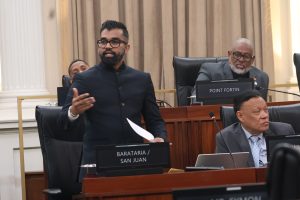
During the debate, opposition legislator, Keith Scotland said the bill would affect the constitutional rights of freedom of movement, enjoyment of property and the right to due process. Scotland compared the SoE to the zones bill.
“I wish to caution this House in replacing one extraordinary security measure with another, under a different name but with the same dire consequences.”
But Sturge said it is his hope “that going forward, they (PNM) abandon the playing of the race card. Many communities in this country have been left behind because the previous government abdicated its responsibility to the most vulnerable communities.”
He said the PNM left these communities in this way “so that they could be exploited for political gain.”
What the ZOSO bill says
Sturge said the legislation is not an SoE and does not have the sweeping powers granted to the security forces by an SoE. He said the bill clearly states this is so because the entire nation cannot be declared a zone of special operation.
He said the bill makes provisions for certain areas in the zones to be cordoned off for a maximum of 24 hours and a curfew to be imposed within the cordon for a maximum of 72 hours. The curfew exists only in the area of the zone where the cordon is, and not the entire zone, rejecting claims by some social media bloggers that all people within the cordon and the zone will be subject to arbitrary arrest, search or detention by the authorities.
“Where cordons and curfews are imposed, operations will be surgical and timely and would target only those persons and premises who are subject to what we call in law ‘reasonable suspicion,’ which is a safeguard.”
Chamber wants communication
Meanwhile, the Trinidad and Tobago Chamber of Industry and Commerce (TTCIC) is calling for communication on the implementation and impact of ZOSOs saying it has noted the government’s intention to deploy ZOSO as part of its security response.
The private sector group says that while crime and public safety remain issues for national stability and economic activity any special security measure should be implemented within defined time frames and as part of a wider strategy that includes social and economic considerations. It said the private sector is focused on how ZOSO measures may affect commercial activity.
According to the Chamber, there is concern about how restrictions connected to ZOSO could affect communities and businesses if the measures are not explained to the public. The organisation said limits on movement, operating hours, or access to specific areas could affect workers, customers, supply chains, and business transactions.
“Restrictions on movement, operating hours, or access to communities if not clearly communicated and carefully managed may affect workforce mobility, customer access, supply chains, and cash flow, particularly for small and medium-sized enterprises.
“The TT Chamber therefore underscores the importance of clear protocols, advance notice, and ongoing engagement with affected businesses to minimise disruption, preserve confidence in the operating environment, and ensure that security objectives are achieved without unintended consequences for lawful economic activity.”
It said that communication between authorities and the business community should continue throughout the period of any ZOSO and that such engagement would support economic activity while allowing security objectives to be pursued. (CMC)